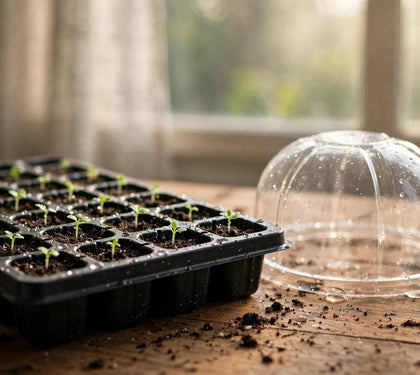


Here's a scene we get at the counter all the time: a grower shows us a photo of droopy, unhappy plants and says, "I don't get it — my temperature is 79 and my humidity is 55, both are supposed to be fine." And on paper, they are. But the plants aren't reading the same numbers the grower is. They're responding to a single combined force that temperature and humidity create together — and that force is called VPD: vapor pressure deficit.
VPD is the single most useful environmental number in indoor growing, and the least understood. This guide explains what it is in plain English, gives you stage-by-stage targets and a lookup chart you can tape to the tent wall, and shows you how to actually steer it with the gear you already own — or the gear that makes it automatic.
What VPD actually is, in plain English
Air is thirsty. Warm air can hold a lot of water; cool air holds less. VPD measures how thirsty the air is — technically, the difference between how much water vapor the air around a leaf could hold at leaf temperature and how much it's actually holding, expressed in kilopascals (kPa).
Why the plant cares: a plant drinks through its roots and loses water through tiny pores in its leaves, a process called transpiration. That water loss is the engine of the whole plant — it's what pulls fresh nutrients up from the roots. The thirstier the air (high VPD), the harder the air pulls water out of the leaves. The more humid and satisfied the air (low VPD), the gentler the pull.
- VPD too low (air too humid for the temperature): transpiration slows to a crawl. Nutrient uptake stalls, calcium and magnesium deficiencies show up even when the feed is perfect, growth goes soft, and the damp, still conditions invite powdery mildew and bud rot.
- VPD too high (air too dry for the temperature): the plant loses water faster than the roots can replace it. Leaves curl and taco, tips burn, the plant closes its pores and stops growing to protect itself — and a stressed plant is a pest magnet.
- VPD in range: the plant transpires steadily, drinks steadily, eats steadily. This is the zone where everything else you're doing — lights, feed, genetics — can actually express itself.
The key insight is that temperature and humidity are meaningless alone. 55% humidity is gentle at 72°F and punishing at 88°F. VPD is the number that tells the truth.
The number everyone skips: leaf temperature
Real VPD is calculated at the leaf surface, not the room air — and leaves under LED light typically run about 2°F cooler than the surrounding air (under older HID lighting they can run warmer, which is one reason HPS rooms behaved differently). That 2-degree gap doesn't sound like much, but it shifts VPD by roughly 0.1–0.2 kPa — often the difference between "in range" and "out of range."
Measuring it is simple: an inexpensive infrared thermometer, pointed at the canopy from a foot or two away, gives you leaf temperature in a second. Take three or four readings across the canopy and average them. Every serious grower we know owns one, and they're in our Meters & Testing collection next to the hygrometers you'll want at canopy height — not on the floor, not on the wall by the door.
Stage-by-stage VPD targets
Young plants with small root systems can't replace water quickly, so they want gentle, humid air (low VPD). Mature flowering plants are drinking hard and benefit from a firmer pull (higher VPD) — which also keeps late-flower humidity low enough to protect dense flowers from rot. All values below use leaf temperature ≈ air temperature − 2°F, typical under LED.
| Growth stage | Target VPD (kPa) | Example setting that lands there | What it does |
|---|---|---|---|
| Clones & seedlings | 0.4 – 0.8 | 78°F air, 70% RH → ~0.77 | Gentle pull while roots establish; prevents wilt |
| Early veg | 0.8 – 1.0 | 80°F air, 65% RH → ~1.00 | Steady drinking and nutrient uptake as growth accelerates |
| Late veg | 1.0 – 1.2 | 80°F air, 60% RH → ~1.18 | Full transpiration; hardens plants for flower |
| Early flower (weeks 1–4) | 1.2 – 1.4 | 82°F air, 60% RH → ~1.26 | Strong pull drives flower development |
| Late flower (weeks 5+) | 1.4 – 1.6 | 84°F air, 55% RH → ~1.54 | Drier air protects dense flowers; keeps metabolism high |
The lookup chart
Find your air temperature, find your humidity, and read your approximate VPD (leaf temperature assumed 2°F below air). Photograph it, print it, tape it to the tent.
| Air temp | 40% RH | 50% RH | 60% RH | 70% RH |
|---|---|---|---|---|
| 70°F | 1.34 | 1.09 | 0.84 | 0.59 |
| 75°F | 1.59 | 1.29 | 1.00 | 0.70 |
| 80°F | 1.88 | 1.53 | 1.18 | 0.83 |
| 85°F | 2.21 | 1.80 | 1.39 | 0.98 |
Read the chart and a few truths jump out. At 85°F and 40% humidity — a very common "my numbers look okay" room — VPD is 2.21, deep in stress territory. At 75°F and 70% humidity it's 0.70, clone weather, no matter what stage the plant is in. The chart is why chasing temperature alone, or humidity alone, fails so many growers.
Steering VPD: the four levers
Once you can read the number, moving it is straightforward. There are only four levers, and most rooms need two of them:
- Temperature up → VPD up. Temperature down → VPD down. Your lights are the biggest heat source. Raising light height or dimming slightly, improving exhaust, or cooling the room all move the needle. Remember the lights-off swing: when lights go out, temperature falls and humidity spikes, and VPD can crash for hours every night. Many "mystery" mildew problems are really lights-off VPD crashes.
- Humidity up → VPD down. A humidifier in the space (or in the lung room feeding it) is the fix for dry-air stress — the classic New England winter problem, when heated indoor air can sit at 25–30% RH and even a cool tent runs a harsh VPD.
- Humidity down → VPD up. This is where a real dehumidifier earns its keep, especially in flower and doubly so in a New England summer or a damp basement. Size matters: an undersized unit runs constantly and still loses. Our Dehumidifiers collection runs from tent-sized units up to commercial Quest and Anden machines, and sizing by the room's actual water load — not the box's marketing number — is a conversation we're happy to have in the shop.
- Airflow evens it out. VPD varies within a canopy: the microclimate right at the leaf surface is what counts. Gentle, constant canopy movement keeps the whole room at one VPD instead of five different ones.
Automating it: let a controller hold the line
Everything above can be done by hand, and plenty of growers do — checking twice a day and adjusting. But VPD drifts every time the weather changes, the lights cycle, or the plants get bigger and transpire more. This is exactly the job environmental controllers exist for. A modern controller reads temperature and humidity at the canopy, computes VPD continuously, and runs your exhaust fan, humidifier, and dehumidifier to hold a target you set by growth stage. The good ecosystems — AC Infinity's controllers and the TrolMaster Hydro-X line are the two we sell and support most — will show you live VPD on your phone and log it, so you can see the lights-off crash with your own eyes and fix it for good.
Our honest advice: if you're running more than one device to manage climate (fan plus humidifier, or fan plus dehumidifier), a controller from the Controllers collection will pay for itself in one saved crop. Start with the sensor at canopy height and the VPD display; add devices as your room grows.
New England notes
Growing on the North Shore means fighting the weather in both directions. Winter: heated air is brutally dry — expect to add humidity from November through March, especially in veg. Summer: the problem flips — humid air rolls in, basements sweat, and late-flower rooms need serious dehumidification to stay in the 1.4–1.6 range safely. Basement grows run cooler and damper year-round, which is free temperature control in summer and a mildew invitation in flower if you skip the dehumidifier. Plan your VPD gear for the season you're growing into, not the one you're in.
The five VPD mistakes we see most
- Chasing humidity alone. 60% RH is perfect at one temperature and a problem at another. Always read the pair as VPD.
- The hygrometer is in the wrong place. It belongs at canopy height, in the light, where the plants live — not in a shaded corner near the floor.
- Ignoring lights-off. Check your min/max readings in the morning. The dark period is where VPD goes wrong quietly.
- Forgetting leaf temperature. Using air temperature alone overstates VPD under LED by a meaningful margin. The infrared thermometer is a $20 truth-teller.
- One setting all run long. Clones at flowering VPD wilt; flowering plants at clone VPD rot. The target moves with the stage — that's the whole point of the chart.
Anthony's Take: "Everything needs to be in sync in your garden. If you have high temps and humidity, you better have the proper lighting and CO2 levels to back them up!"
Frequently asked questions
Do I need a special meter to measure VPD?
No single "VPD meter" is required. You need air temperature, relative humidity, and leaf temperature (infrared thermometer). Many modern controllers and smart hygrometers calculate and display VPD for you once they have those inputs — check Meters & Testing for options at every budget.
What's more important: hitting VPD exactly, or keeping it stable?
Stable, and it isn't close. A room that sits at 1.1 all day beats a room that swings between 0.7 and 1.6 chasing a perfect 1.2. Plants adapt to a steady environment; they stress on roller coasters.
My VPD is fine during lights-on but crashes at night. What do I fix first?
Usually lights-off humidity: plants keep transpiring, temperatures fall, and humidity spikes. A dehumidifier that runs on its own humidistat through the dark period is the standard fix, and it's why we ask about your dark-period numbers before recommending any other gear.
Does VPD matter for soil grows, or just hydro?
It matters for every plant in every medium — transpiration is how all plants move water and nutrients. Soil growers actually feel VPD problems as watering problems: a high-VPD room drinks pots dry unevenly, and a low-VPD room keeps media wet and roots unhappy.
Where should I set my exhaust fan?
Let the controller logic decide based on which lever you need: exhausting removes heat and humidity together. In winter-dry rooms, aggressive exhaust can crash humidity and spike VPD, so a controller modulating fan speed beats a fan on a simple timer almost every time.
Bring us your numbers — temp, RH, and a leaf-temp reading if you have one — at the shop at 82 Newbury St in Peabody, and we'll do the VPD math with you at the counter and tell you honestly which lever your room actually needs.