

Every February, the same ritual plays out at our counter. Somebody comes in holding a seed packet like it's evidence in a trial: "It says start indoors 6 to 8 weeks before last frost. Okay — but when is that, here?" It's the right question, and it's the one the packet can't answer. The seed companies write their calendars for a generic somewhere-in-America spring. We grow on the North Shore of Massachusetts, where "spring" can mean 60 degrees and sunny on Tuesday and a frost warning on Friday. This guide is the calendar we actually give people at the shop — built around our frost dates, our soil, and our short, beautiful season.
Whether you're starting tomatoes and peppers for the backyard, greens for a fall harvest, or cannabis and hemp seed for an outdoor run, the principles are identical: count backwards from last frost honestly, give seedlings real light and warm soil, and harden them off before the real world hits them. Get those three things right and seed starting stops being a gamble.
First, know your frost dates — ours, not the packet's
Peabody sits in USDA Zone 6b, with pockets of 7a right along the coast. That zoning tells you about winter lows, but seed starting runs on two different dates: your average last spring frost and your first fall frost. On the North Shore, the last spring frost lands somewhere between mid-April near the water and early May a few miles inland — and "average" means exactly what it sounds like: in half of all years, a later frost than that shows up and wipes out tender transplants that went out early. The first fall frost typically arrives in mid-to-late October, later right on the coast.
So we teach two anchors at the shop, not one:
- The counting date (late April): use this to schedule your indoor sowing. It's the fulcrum every "weeks before last frost" instruction hangs off.
- The safe date (mid-May, and Memorial Day for the tenderest crops): use this for actually putting warm-weather plants outside. Tomatoes, peppers, basil, squash, and cannabis all hate cold soil and cold nights more than they hate an extra week indoors.
That split — sow by the calendar, transplant by the safe date — is the whole New England trick. The growers who lose plants here almost never lose them to a late start. They lose them to an impatient one.
The North Shore seed-starting calendar
Here's the working calendar, counted back from a late-April last frost. Every crop below shows up in our Seedling Supplies aisle every spring, and the seeds themselves live in Seeds. Adjust a week either way for your exact microclimate — coastal Essex County runs a touch warmer than inland Middlesex.
| When to sow indoors | What to start | Why that timing |
|---|---|---|
| Early–mid February (10–12 weeks out) | Onions & leeks from seed, celery | The slowpokes. They need a long indoor runway to size up before transplant |
| Late February–early March (8–10 weeks out) | Peppers — superhots first, then bells; eggplant at the tail of this window | Peppers germinate slow and grow slow. Superhots can take 3+ weeks just to sprout |
| Mid–late March (6–8 weeks out) | Tomatoes | The classic mistake is starting them in February — by May you've got leggy vines falling over. Six to eight weeks is plenty |
| Late March–early April (4–6 weeks out) | Broccoli, cabbage, cauliflower, kale; head lettuce; herbs like parsley (slow!) and thyme | Cool-weather crops that transplant young and don't mind a chilly April garden |
| Mid–late April (2–4 weeks out) | Basil; cannabis & hemp seed destined for outdoor transplant | Basil is frost-tender and fast — early starts just get woody. Outdoor cannabis started now transplants at a perfect size in late May |
| Late April (0–2 weeks out) | Cucumbers, squash, melons — or skip indoors entirely | Cucurbits hate root disturbance and grow fast. Most years, direct-sowing in warm late-May soil beats transplanting |
| Mid–late May (direct sow outside) | Beans, corn, sunflowers; second rounds of greens for fall | These want warm soil, not a head start. Beans in cold soil simply rot |
One more line for the cannabis growers: photoperiod plants started indoors need a light schedule that won't confuse them at transplant. Keep seedlings on roughly 16–18 hours of light, and don't move them outside until the natural day is long enough — mid-to-late May here — or they'll start flowering the week they go out and reveg themselves into a mess. Autos sidestep all of this, which is half of why they're so popular for New England outdoor.
The seedling station that actually works
You don't need much gear, but the three pieces you do need each solve a specific, common failure. Everything here is on the shelf in Seedling Supplies.
1. Warmth at the root zone
Seeds germinate on soil temperature, not air temperature, and a tray sitting on a basement table in a Massachusetts February is sitting on 55°F concrete no matter what the thermostat says. Most of our crops want 70–85°F soil to sprout well — peppers and tomatoes at the top of that range, cannabis right around 75–80°F. A seedling heat mat with a thermostat is the fix: the 10″ × 20.75″ mat size fits a standard tray, and one with a controller (the AC Infinity SUNCORE S3 is the one we hand people most) runs $21.99. Set it to 75–80°F, and the day your seeds sprout, the mat's job changes — seedlings want it cooler from there, around 60–70°F, or they stretch. Mats are for germination, not for the whole childhood.
2. Real light, close and long
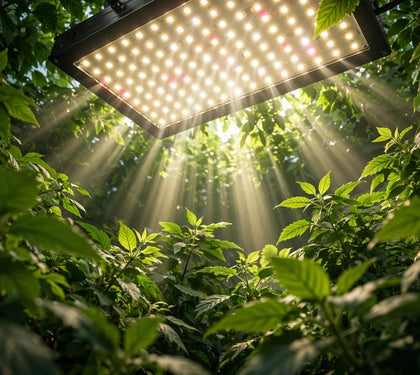
The windowsill is the number-one seedling killer in New England — not because the light is bad, but because there isn't enough of it in February and March, and seedlings respond by stretching into pale, floppy threads reaching for a sun that isn't there. The fix is unglamorous: a simple LED or fluorescent fixture hung 2–4 inches above the tops of the plants, raised as they grow, on for 14–16 hours a day (18 for cannabis seedlings). If your seedlings are leaning hard toward the window and standing on stilts, they're not defective — they're telling you the light math doesn't work. A fixture they can't out-stretch is cheaper than re-sowing in April.
3. A dome for germination, air for everything after
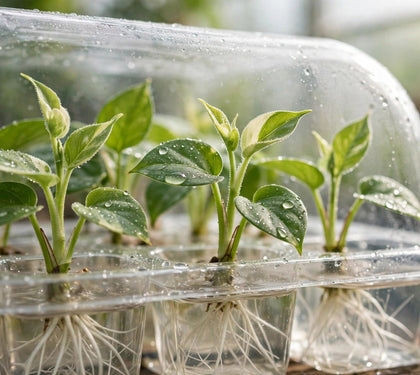
A humidity dome over the tray keeps the seed zone moist through sprouting — genuinely useful. The mistake is leaving it on. The moment most seeds are up, the dome comes off and a small fan on low goes on. Still, saturated air around a tender stem is exactly what damping-off fungi want (more on that below), and gentle air movement makes stems stocky and strong — plants literally build sturdier tissue when they're moved. Wiggle your seedlings with a breeze and they grow up like they mean it.
The medium and the first feed
Start seeds in a fine, low-charge seed-starting mix — not in potting soil straight from the bag, and definitely not in garden soil, which brings fungus and weed seed to the party. A purpose-made starter mix is mostly fine peat or coco with perlite: it holds moisture evenly, drains freely, and carries almost no fertilizer, because a seed brings its own lunch for the first week or two. Your first feeding — quarter-strength at most — comes after the first true leaves appear, not the seed leaves (cotyledons) the plant hatches with. Drowning young seedlings in full-strength nutrient is the second most common way we see them die, right behind the windowsill.
The three failures we troubleshoot all spring
Nothing sprouted. Work the checklist in order: Was the soil warm enough? (Cold soil is the usual answer for peppers.) Was the seed buried too deep? (The rule is 2–3× the seed's width — tiny seed like celery barely gets covered at all.) Did it dry out mid-germination? A seed that starts to sprout and then dries is dead, full stop — consistent moisture matters more than soaking. And how old was the seed? Parsnip seed is basically dead after a year; tomato seed is good for five. Fresh seed, warm soil, steady moisture solves nine cases out of ten.
They sprouted and then fell over at the base. That's damping off — a fungal attack that pinches the stem at the soil line. It thrives in cool, wet, still air: dome left on, soil kept soggy, no fan. Prevention is the whole game: dome off at sprouting, water from the bottom, run the fan, and don't sow in last year's used mix. A tray that damps off rarely recovers; re-sow clean rather than nursing it.
They're tall, pale, and flopping. Light. Always light. Move the fixture down to a few inches over the canopy, extend the photoperiod, and get the fan on them. Leggy tomato seedlings can be rescued at transplant by burying the stem deep — tomatoes root along the buried stem — but most crops can't. Next round, fix the light.
Hardening off: the week nobody wants to do
A seedling raised indoors has lived its whole life in a climate-controlled spa: no wind, no direct sun, no temperature swings. Put it straight into a May garden and the sun alone will scorch it white in an afternoon — indoor leaves genuinely sunburn, because they've never needed sunscreen. Hardening off is the acclimation week: an hour or two of shaded outdoor time on day one, building daily toward full sun and full days by day seven to ten, pulling them in if nights threaten to drop below 50°F for tender crops. It is tedious. It is also the difference between transplants that take off and transplants that sit there sulking for three weeks. Cool-season crops (the brassicas, lettuce, onions) harden faster and handle cold nights; the tender crowd — tomato, pepper, basil, cannabis — gets the full week and the safe date, no exceptions at our shop.
Anthony's Take: “People often forget to soak their seeds before planting — rehydrating the seed (imbibition) is key!”
Frequently asked questions
What's the actual last frost date for the Peabody area?
There's no single date — that's the trap. The average last spring frost on the North Shore falls between mid-April (coastal) and early May (inland), and an "average" year still leaves a coin flip of a later frost. Sow indoors counting back from late April, but don't put tender crops outside until mid-May at the earliest, and Memorial Day weekend is the old Yankee safe date for a reason.
Can I start seeds in regular potting soil?
You can, and plenty survive — but a dedicated seed-starting mix is finer, drains better, and won't burn sprouts with a fertilizer charge they don't need yet. If potting soil is what you have, sift out the big chunks, don't add any fertilizer until true leaves appear, and be extra careful not to keep it soggy.
How deep should I plant seeds?
Two to three times the seed's own width is the rule. A tomato seed goes about a quarter inch down; a pepper seed about the same; tiny seeds like celery, lettuce, and many herbs get pressed onto the surface with barely a dusting over them — some need light to germinate at all. If in doubt, err shallow and keep the surface moist.
My seedlings are leaning toward the window. Can I just rotate the tray?
Rotating helps them grow straighter, but it doesn't fix the real problem: there isn't enough light, and they're stretching for it. Rotated seedlings still end up leggy and weak. Hang a fixture a few inches above them for 14–16 hours a day and the leaning stops because the reaching stops.
When do I feed seedlings for the first time?
After the first set of true leaves — the leaves that look like the actual plant, not the round seed leaves they hatch with. Start at quarter strength. Seeds carry their own starter energy, and full-strength nutrient on a two-leaf seedling is a reliable way to burn it.
Starting a spring round? Everything in this guide — trays, domes, heat mats, lights, seed-starting mix, and the seeds themselves — is on the shelf at Green Harvest Hydroponics, 82 Newbury St in Peabody. Bring us your packet and your planting date and we'll sanity-check the math at the counter. We're open Mon–Sat 10–6 and Sun 10–3, at 978-278-5898, and everything here is online at ghhydro.com.